

The Rule of Three: Mastering the 3-Layer System
- Posted on
- 0
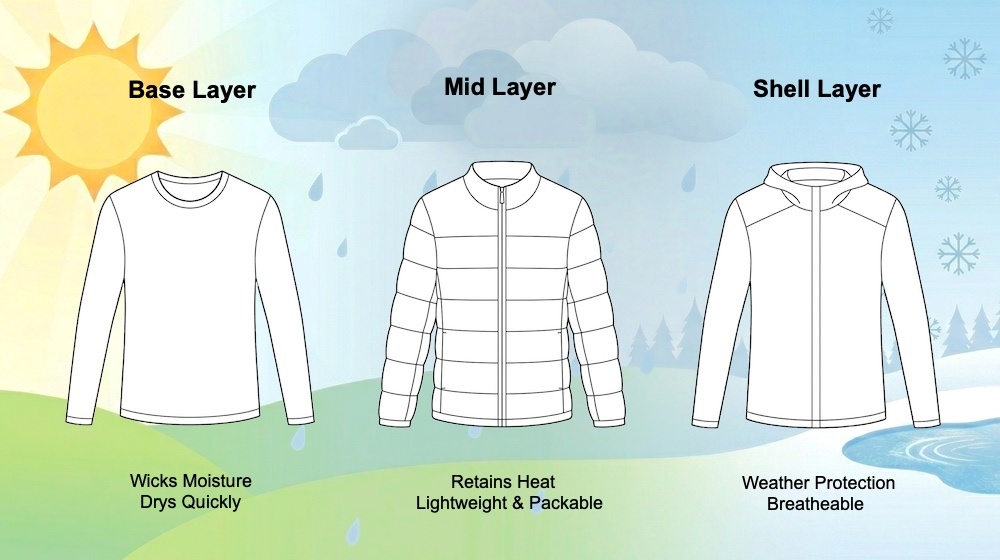
Get an overview of 3-piece layering, a dress system that will allow you to stay comfortable in any weather. Dive deep on specific layers to find the garment that will take your kit to the next level.
The Rule of Three: Mastering the 3-Layer System
There is no such thing as "bad weather"—only a breakdown in your layering system. To get the most out of technical apparel, you have to move beyond individual pieces and start building a performance system.
The Base Layer
Moisture Management
The base layer is your most critical layer. Its job is to move sweat away from your skin. If moisture stays against your body, it draws away heat, leading to a "flash chill" the moment you stop moving.
- Synthetics: Best for high-intensity movement.
- Merino Wool: Natural heat regulation and odor resistance.
- Avoid Cotton: Cotton traps moisture and leaves you feeling damp and cold.
Fabric Tech: Wool vs. Synthetics
Merino Wool (The Natural Standard): Wool is highly hydrophilic and hygroscopic, meaning it absorbs moisture vapor into its core. It can hold up to 35% of its weight in moisture without feeling wet.
This works via a complex fiber structure: a hydrophilic inner cortex that pulls vapor in, and a hydrophobic outer cuticle that repels liquid. As wool absorbs this vapor, it triggers a chemical reaction called sorption heat, releasing energy that keeps the wearer warm even when the fabric is damp. It is naturally antimicrobial, making it the best choice for multi-day trips.
Synthetics (The Performance Choice): Unlike wool, polyester and nylon are hydrophobic. They do not absorb moisture into the fiber itself; instead, they use "capillary action" to move liquid moisture along the surface of the fibers to the outside of the garment.
Synthetics are the fastest-drying option and offer superior durability. They are the primary choice for high-output activities in humid conditions where rapid evaporation is the highest priority.
The Mid Layer
Insulation & Heat Retention
The mid layer traps body heat while remaining breathable enough to let vapor continue its journey outward. This is the most versatile part of your kit.
- Fleece: Maximum breathability for high-output climbs.
- Synthetic: A balance of performance, packability, and damp-weather reliability.
- Down: The gold standard for warmth-to-weight in dry cold.
Insulation Material Comparison
Fleece (Active Breathability): Fleece is essentially a synthetic knit designed to mimic the loft of wool. It provides excellent air permeability, allowing wind to move through the fabric to carry away excess heat.
Best for: High-output activity where you are sweating heavily but need to keep core warmth.
Synthetic Insulation (Damp-Weather Reliability): These pieces use polyester filaments to create a trapped-air space. This trapped-air is what gives synthetics and down their superior insulating abilities. Unlike down, synthetic fibers are moisture-resistant and maintain their loft (and warmth) even if they get wet.
Best for: Humid environments, rainy days, or high-exertion activities in the cold where you might sweat through your layers.
Down (The Gold Standard): Down provides the highest warmth-to-weight ratio and is the most compressible (packable) option. However, if down gets wet, the clusters collapse and lose all insulating properties.
Best for: Dry, bitter cold and activities where weight and pack space are the primary concerns.
The Shell Layer
The Weather Shield
The shell is your defense against wind, rain, and snow. It blocks the elements while letting internal sweat vapor escape.
- Hardshell: Total waterproof protection for storms.
- Softshell: Breathable wind resistance for active movement.
Shell Tech
Shell Construction:
Staff Tip: The following "Layers" refer specifically to the materials used to construct a shell (i.e. Face fabric, waterproof membrane, lining fabric) and should not be confused with the more general layers (i.e. Base, mid, shell) outlined in this article.
2-Layer (Traditional Comfort): 2L construction bonds the waterproof membrane to the outer face fabric but uses a separate hanging liner on the inside.
Best for: Casual use or resort skiing. They are comfortable but often bulkier and heavier.
2.5-Layer (Lightweight/Packable): These bond the membrane to the face fabric and use a printed pattern or "half-layer" on the inside to protect the membrane.
Best for: Fast-and-light hiking or emergency rain shells. They are incredibly packable but can feel clammy against the skin during high exertion.
3-Layer (High-performance): 3L shells bond the outer face, the membrane, and a high-performance inner liner into one single composite fabric.
Best for: Harsh mountain environments and long-term durability. This is the most breathable and rugged construction, providing the best moisture management and "next-to-skin" feel.
Single-Layer (Wind Shells): Windbreakers usually skip the membrane entirely in favor of a very tight weave. While not waterproof, they offer much higher air permeability (breathability) than a hardshell. A windbreaker is typically worn directly over a base layer and doesn't fit into a traditional 3-piece layering system. However, for specific use-cases, such as biking or running, they are invaluable.
Best for: High-output cardio in dry, windy conditions where a waterproof shell would cause you to overheat.
The Critical Role of DWR:
Durable Water Repellent (DWR) is a chemical coating on the outside of the fabric. It causes water to bead up and roll off.
Why it matters: If the DWR fails, the face fabric "wets out" (gets soaked). Even if the membrane is still waterproof, a soaked face fabric creates a "water-wall" that blocks sweat vapor from escaping, making you feel cold and clammy inside.
Staff Tip: If your jacket stops beading water, it's time to wash it to reactivate the coating! Use a technical cleaner specific for waterproof shells and, if necessary, reapply the DWR. Nikwax products make this an easy process you can do at home!
Staff Note
The beauty of the 3-piece system is versatility. You can wear just the base for high-exertion activities. Add the shell layer to keep out a breeze or precipitation without overheating yourself. Wear all three when you need the most warmth and protection. By mixing-and-matching three solid pieces of gear you can be comfortable during any activity, no matter the weather!
Ready to optimize your kit?

Comments
Be the first to comment...